East Bay
Test Strips
Visit the live site (opens in a new tab)
Cash for Unused Diabetic Supplies, Same Day
East Bay Test Strips buys unused, unexpired diabetic supplies directly from people in the East Bay: Dexcom sensors, Omnipod pods, FreeStyle Libre sensors, test strips, and insulin pump accessories. Same-day pickup, same-day payment via cash, Venmo, Zelle, or PayPal, seven days a week.
The premise is simple. Insurance ships quarterly. Prescriptions change. CGM systems get upgraded. Supplies stack up in drawers and eventually expire unused. People have no easy way to recoup any value, and throwing away a box of Dexcom G6 sensors that still carries real cash value feels wrong. This business exists to be the buyer.
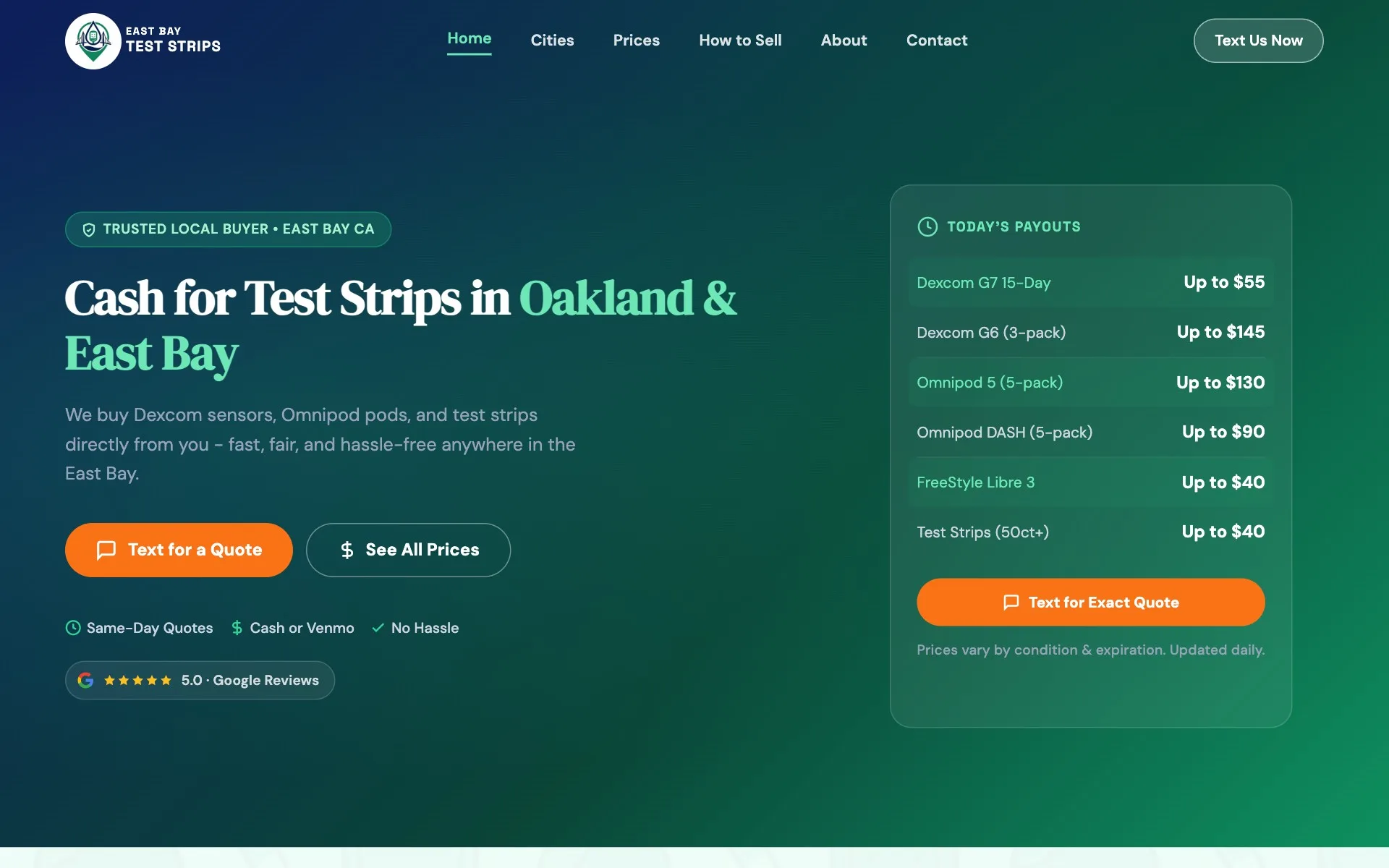 Hero: the value prop beside an example text exchange, so the whole quote process is visible before anyone scrolls
A Business With No Web Presence in a Search-Driven Market
The business existed before a dedicated website did. Early traction came through Craigslist and word of mouth, which worked but hit a ceiling fast. The problem was that people searching for exactly this service ("sell Dexcom sensors Oakland," "cash for test strips near me," "where to sell diabetic supplies East Bay") were finding nothing. Every high-intent search was going to waste.
Building a site wasn't optional. It was the only real growth path. But the design constraints were specific: the primary conversion action is a text message, not a form. Someone lands on the page, they need to know what we pay, confirm the business is legitimate, and feel comfortable texting a stranger their address. In under ten seconds. On a phone.
No Organic Traffic
Zero web presence meant zero discovery from search. Every lead required active sourcing: Craigslist posts, repeat postings, manual effort that didn't compound.
High-Intent Searches, No Results
"Sell Dexcom Oakland," "cash for CGM sensors," "sell diabetic supplies near me". These are people ready to transact right now. None of them were finding us.
Trust Gap
Buying medical supplies from a stranger is a trust problem. Without a proper site (pricing, reviews, a legality FAQ, a real phone number) there's no reason to text.
Four Questions, Answered Before the Scroll
Every visitor arrives with the same four questions. Do you buy what I have? How much will you pay? Is this legitimate? How do I get paid? The site is designed to answer all four above the fold on mobile, then get out of the way.
The primary CTA is "Text for Quote," repeated throughout, never buried. No forms. No quote calculators. A text with brand, quantity, and expiration date is all it takes, and the site makes that feel obvious rather than uncertain.
A Quote in Minutes, Not a Form
The site answers "how much will you pay" with speed rather than a price list. Send a text with brand, quantity, and expiration date and an offer comes back within minutes, with no obligation to accept. A condition guide sets expectations before anyone texts, so a dinged box reads as a price adjustment rather than a rejection.
Trust Signals Front and Center
5.0 Google rating displayed prominently. Real phone number, real email, real location. A clear FAQ on legality. These aren't afterthoughts. They're answers to the objections that kill the conversion before anyone texts.
Three-Step Process
Text your brand, quantity, and expiration date. Get an offer within minutes. Choose pickup or shipping, get paid same day. That's the whole process. The site explains it in under 50 words so no one is left wondering what happens next.
Mobile-First Layout
Over 70% of traffic arrives on a phone, most of it direct from a Google search. The design is built for that context: large tap targets, phone number click-to-call, pricing visible without horizontal scroll.
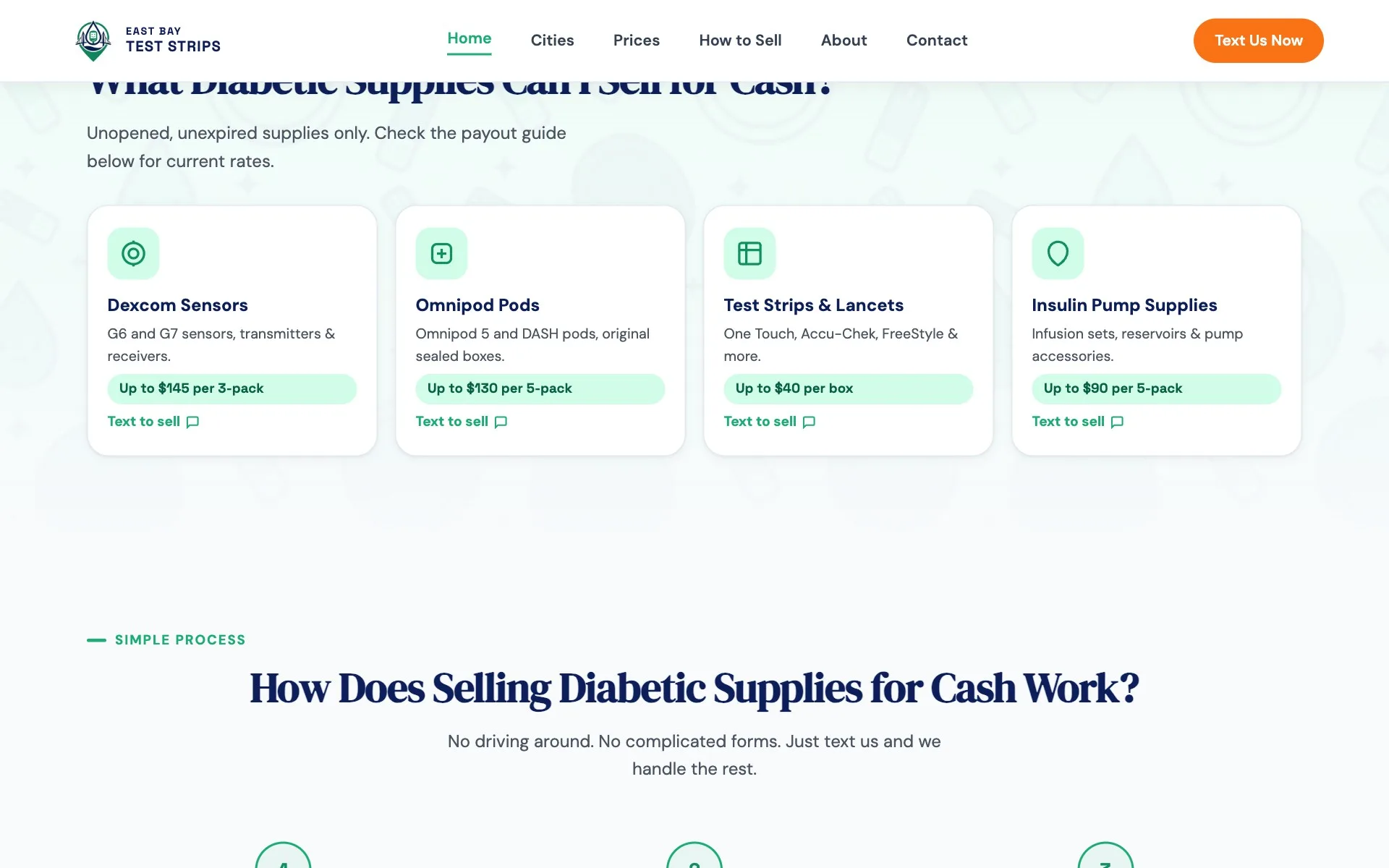 Product categories: every supply type we accept, each with its own text-to-sell action
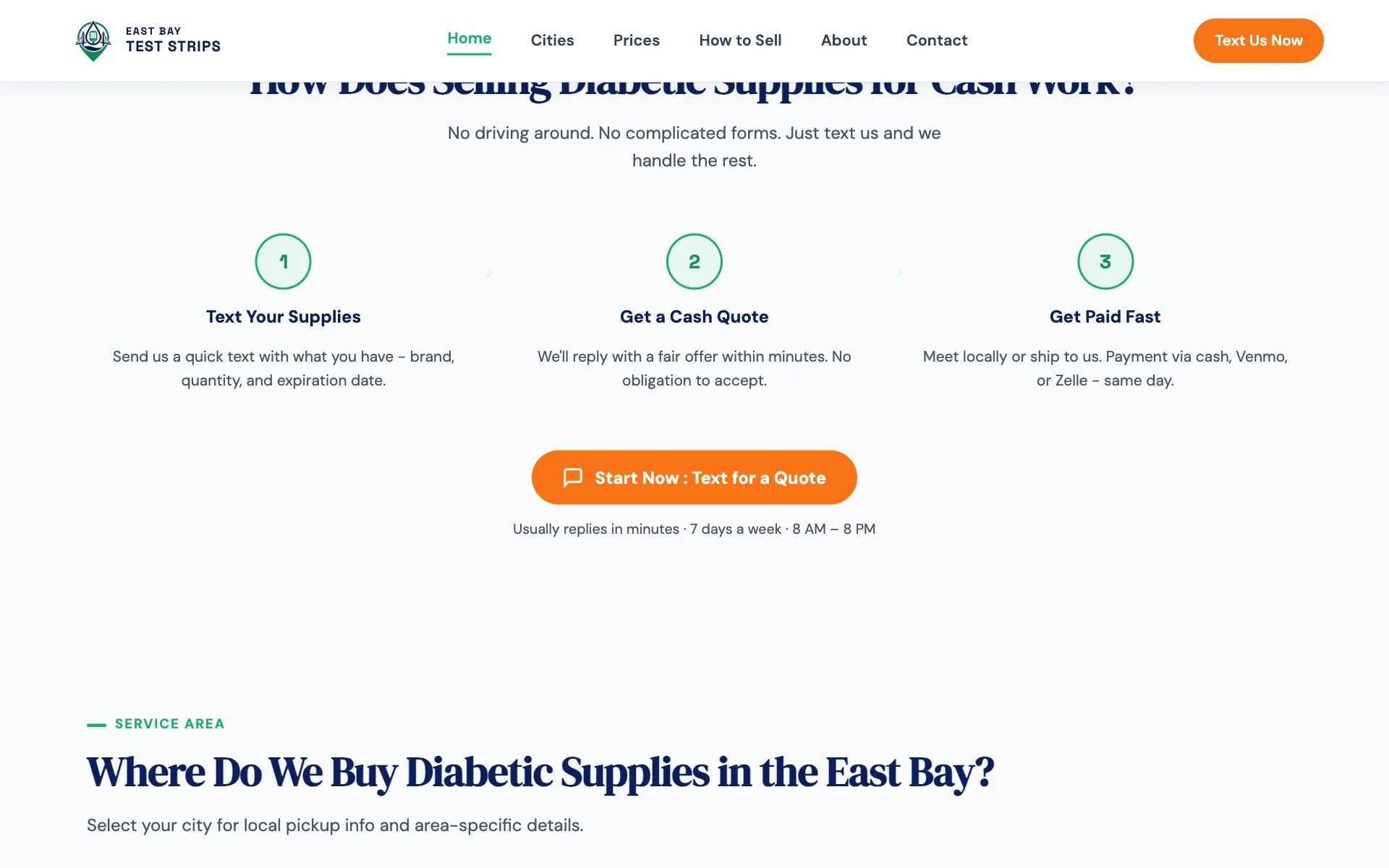 Three steps: text, get offer, get paid, under 50 words
Built to Rank for the Searches That Actually Drive Leads
People don't search "cash for diabetic supplies" in the abstract. They search with location intent: "sell Dexcom sensors Oakland," "cash for CGM near Fremont," "where to sell test strips in Berkeley." The site is architected around that behavior.
City-specific pages for Oakland, Hayward, Fremont, Berkeley, San Leandro, and Richmond each target the same service with locally relevant copy. Combined with a fully optimized Google Business Profile and consistent NAP across directories, the site earns placement in the local map pack for the exact queries that drive real inbound leads.
City Landing Pages
Separate pages for Oakland, Hayward, Fremont, Berkeley, San Leandro, and Richmond. Each targets local search terms with unique, relevant copy rather than duplicated boilerplate.
Google Business Profile
Fully built out GBP with accurate categories, service area, hours, photos, and Q&A. The map pack is where high-intent local searches convert. Being absent from it isn't an option.
Product-Specific Pages
Dedicated pages for Dexcom, Omnipod, FreeStyle Libre, and test strips. Captures long-tail searches from people who know exactly what they have and are looking for a specific buyer.
Revenue From Search Alone
East Bay Test Strips started in April 2026. Since then it has averaged $2,000 to $3,000 a month in revenue. From launch until mid-September there was no ad spend behind it and no paid placement: every lead came from organic search.
Every search lead arrives the same way. Someone searches for a buyer, lands on the site, and sends a text. The SEO architecture does the work of getting found. The quote turnaround does the work of keeping them once they arrive.
East Bay Test Strips is ours. We own it, we run it, and we did its SEO ourselves, which means there is no client budget behind the result and nobody else to credit for it. That makes it the cleanest test of the method on this site. The figure above is a running monthly average rather than a single peak month, and it is revenue, not profit.
What Google’s own data shows
The revenue figure is ours. The traffic figures below are Google’s. This is every click the site has had from Google search since Search Console started recording it in May, alongside organic search visits from Google Analytics.
| Month | Clicks from Google search | Organic search visits |
|---|---|---|
| May 2026 (10 to 31) | 20 | Not tracked |
| June 2026 | 22 | Not tracked |
| July 2026 | 32 | Not tracked |
| August 2026 | 34 | 37 |
| September 2026 (1 to 27) | 32 | 34 |
These are small numbers for a small, specific market. Clicks rose from 22 in June to the low thirties in every month since, and September ran at a little over one a day, the best rate so far. In August and September, when both tools were running, they agree to within a few visits. The table only counts the website. Anyone who calls or texts straight from the Google Business Profile listing never reaches the site, so they do not appear here.
None of the searches Search Console reports by name are for the business itself. The clicks come from people describing what they want to do: “sell diabetic supplies,” “who buys diabetic supplies near me,” “cash for diabetic supplies near me,” “diabetic test strips for cash,” “sell Omnipod 5.” Nobody knew the name, so the site had to be found by what they typed. That is the premise of section 04, showing up in the data.
A small Meta ads test started on 15 September. It does not touch the figures above, which count organic search only.
Losing High-Intent Searches?
East Bay Test Strips was invisible for searches people were already typing. If your category has demand you are not capturing, that is usually fixable and worth fifteen minutes.
Book a 15-Minute Call (opens in a new tab)Or email kyle@bynymbus.com